Guidelines for submitting articles to Santa Rosalia Today
Hello, and thank you for choosing Santa Rosalia.Today to publicise your organisation’s info or event.
Santa Rosalia Today is a website set up by Murcia Today specifically for residents of the urbanisation in Southwest Murcia, providing news and information on what’s happening in the local area, which is the largest English-speaking expat area in the Region of Murcia.
When submitting text to be included on Santa Rosalia Today, please abide by the following guidelines so we can upload your article as swiftly as possible:
Send an email to editor@spaintodayonline.com or contact@murciatoday.com
Attach the information in a Word Document or Google Doc
Include all relevant points, including:
Who is the organisation running the event?
Where is it happening?
When?
How much does it cost?
Is it necessary to book beforehand, or can people just show up on the day?
…but try not to exceed 300 words
Also attach a photo to illustrate your article, no more than 100kb
PROPERTY SEARCH
PROPERTY SEARCH
article_detail
Date Published: 04/08/2026
Millions across Spain set to witness the country's first total solar eclipse in more than a century
The historic event will be followed by the Perseid meteor shower in Spain, making for an unforgettable evening
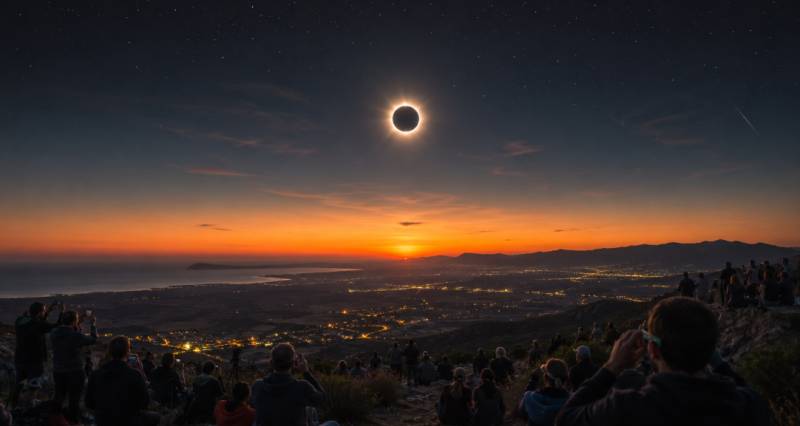
Next Wednesday promises to be one of the most extraordinary evenings Spain has experienced in more than a century as a total solar eclipse sweeps across the country, briefly turning day into night for millions of people.
The eclipse, which takes place on Wednesday August 12, will be the first total solar eclipse visible from mainland Spain since 1912, making it one of the most eagerly anticipated astronomical events of recent decades. It's also the first of what's being dubbed the 'Iberian Trio', with two more major eclipses set to follow in 2027 and 2028.
Astronomy enthusiasts have been counting down to the event for years, but you don't need a telescope to appreciate what's about to happen. For anyone lucky enough to be in the path of totality, the Moon will completely cover the Sun for just over a minute, the sky will darken dramatically and the Sun's glowing outer atmosphere, known as the corona, will become visible.
Where will the eclipse be visible?
The Moon's shadow will travel across Spain from west to east during the evening, with the partial eclipse beginning at around 7.30pm and totality arriving roughly an hour later, shortly before sunset.
The best views will be from a broad band stretching across northern and eastern Spain. Cities including A Coruña, Oviedo, León, Santander, Bilbao, Zaragoza, Tarragona, Valencia and Palma de Mallorca are all expected to experience totality, although the exact duration will vary depending on location.
In most places, darkness will last for less than 90 seconds, but around Oviedo the total eclipse is expected to continue for almost two minutes, making it one of Spain's prime viewing spots.
Even outside the path of totality, much of the rest of the country will still witness a spectacular partial eclipse, although the Sun will never be completely covered.
Because the eclipse takes place close to sunset, experts recommend choosing a location with a clear view of the western horizon, away from buildings or mountains that could block the final stages of the event.
The excitement surrounding the eclipse has already sparked a surge in accommodation bookings in many of the best viewing locations, with visitors travelling from around the world to experience the spectacle.
The first of three rare eclipses
Although next week's event is the headline act, it won't be the last.
The eclipse marks the beginning of the Iberian Trio, a sequence of three major eclipses visible from Spain over the next two years. Another eclipse will take place on August 2, 2027, followed by a third on January 26, 2028, giving Spain one of the most remarkable runs of astronomical events anywhere in the world.
Don't forget your eclipse glasses
As tempting as it might be to glance at the Sun, experts stress that looking directly at a solar eclipse without proper eye protection can cause permanent retinal damage.
The only glasses considered safe are those carrying the EN ISO 12312-2 certification, which is specifically designed for direct solar observation. Glasses should also be checked for scratches, holes or other damage before use.
To help people enjoy the event safely, the Ministry of Science, Innovation and Universities and the ONCE Social Group are distributing two million certified eclipse glasses across Spain.
Around 1.7 million pairs will be available through ONCE's nationwide network of vendors, while a further 300,000 pairs will be distributed by the Spanish Foundation for Science and Technology (FECYT) through science museums, universities and research centres.
Some regional and local authorities are also organising their own giveaways. In Madrid, for example, thousands of free pairs are being handed out at libraries, museums and other municipal buildings until stocks run out.
Anyone unable to collect a free pair can also buy certified eclipse glasses from opticians, specialist retailers, some pharmacies and larger stores like MediaMarkt. Experts warn that glasses marked only ISO 12312-1 are not suitable for viewing an eclipse.
NASA will be watching too
The eclipse isn't just exciting for skywatchers. It also presents a rare scientific opportunity.
NASA plans to fly a specially equipped WB-57 research aircraft at an altitude of around 15 kilometres, following the Moon's shadow as it crosses the Earth. By effectively chasing the eclipse, scientists will be able to extend the period of totality to almost three minutes, giving them valuable extra time to study the Sun's outer atmosphere.
The aircraft's high-tech cameras will capture detailed images of the solar corona, helping researchers investigate why it reaches temperatures of around one million degrees and how material escaping from the Sun forms the solar wind, which can affect satellites, communications and space missions.
NASA will also launch 86 scientific balloons between Iceland and Spain to study how the sudden loss of sunlight affects the Earth's atmosphere.
An unforgettable night for stargazers
As if a total solar eclipse wasn't enough, the evening has one final surprise in store.
The Perseid meteor shower, often known as the Tears of Saint Lawrence, is also expected to peak that night. With a new moon creating exceptionally dark skies once the eclipse has passed, viewing conditions should be among the best of the year for spotting shooting stars.
It's a remarkable combination of events and one that's unlikely to be repeated any time soon.
For many people across Spain, next Wednesday won't simply be another summer evening. It will be the chance to witness a historic astronomical spectacle that most will only ever experience once in their lifetime.
Image generated using AI
article_detail
Address
Casas del Puente 3, Cartagena, Murcia, Spain, 30397
The Astronomy and Science Centre Foundation has star-themed events and activities to delight novices and experts of all ages
Astronomy Tours runs a whole host of astronomical activities and events in the Murcia Region, from astronomical observation sessions to a magical cruise under the stars, to really fire up an interest in the cosmic world beyond our atmosphere.
Their main base of operations is the Finca Astronomica, located close to the town of La Aljorra in the Campo de Cartagena, where you can join their astronomy tours either in the daytime or at night, all year round.
At the Finca, you’re welcomed with delicious food, drinks, a bonfire and a variety of astronomical tools and gadgets. In the summer season, they also have tours in other locations, including San Pedro del Pinatar, La Manga and Camposol, not to mention their unmissable cruise under the stars, which involves a nighttime cruise on the Mar Menor with tapas and drinks, plus a guided presentation of the night sky as you watch the galaxy glide by.
The Astronomy Tours and the Finca Astronomica are supported by the Astronomy and Science Centre Foundation, which was founded in 2019 by a group of astronomers and Starlight-certified guides and monitors in the astronomical observatories in Spain.
The purpose of the Foundation is to promote the knowledge and interest in the field of astronomy and astronomy-related sciences, which covers areas such as physics, chemistry, biology, geology, but also history, archeology, urban and medical aspects of social life, literature, art, culture and (of course) astrology.
By promoting this knowledge and getting their customers interested in astronomy, the Foundation hopes to achieve higher goals such as bringing the stars a little closer to people, and helping them to understand the importance of caring about our planet and the whole human population as a one.
To achieve those goals, the Foundation organises its day- and nighttime activities and camps which are suitable for both children and adults, and as well as this they work with schools and organisations and write books for children to bring astronomy to the masses.
As part of this mission, they’re creating an astronomically themed park right on the Costa Cálida called the Astronomy and Science Centre which has an observatory available to the public to see the stars and the planets, and where they also promote ecofriendly and sustainable activities and closeness to nature.
The Finca Astronomica even has its own friendly and well cared for animals which live in really big spaces where people can easily enter and interact with them in their own environment.
What’s more, you can get involved in all sorts of other fun and activities for all the family at the Finca Astronomica, including glamping under the stars, stroking the animals at their petting zoo and enjoying sports like darts, archery, nerf gun fights, and many more.
This year, Finca Astronomica is excited to unveil its very own Yurt Village. Alongside the beautifully crafted wooden glamping pods, the yurts combine traditional charm with all the modern comforts including double beds, cosy carpets and plenty of shelving for your personal belongings.
But that’s not all. Each yurt comes handily equipped with light and electricity, so that you can charge your devices even as you recharge your spirit under the vast, starry sky.
This summer season is about to come alive with regular tours happening three days a week, while Adult Only Fridays are just around the corner.
Tours are available in English, Spanish and Polish.
















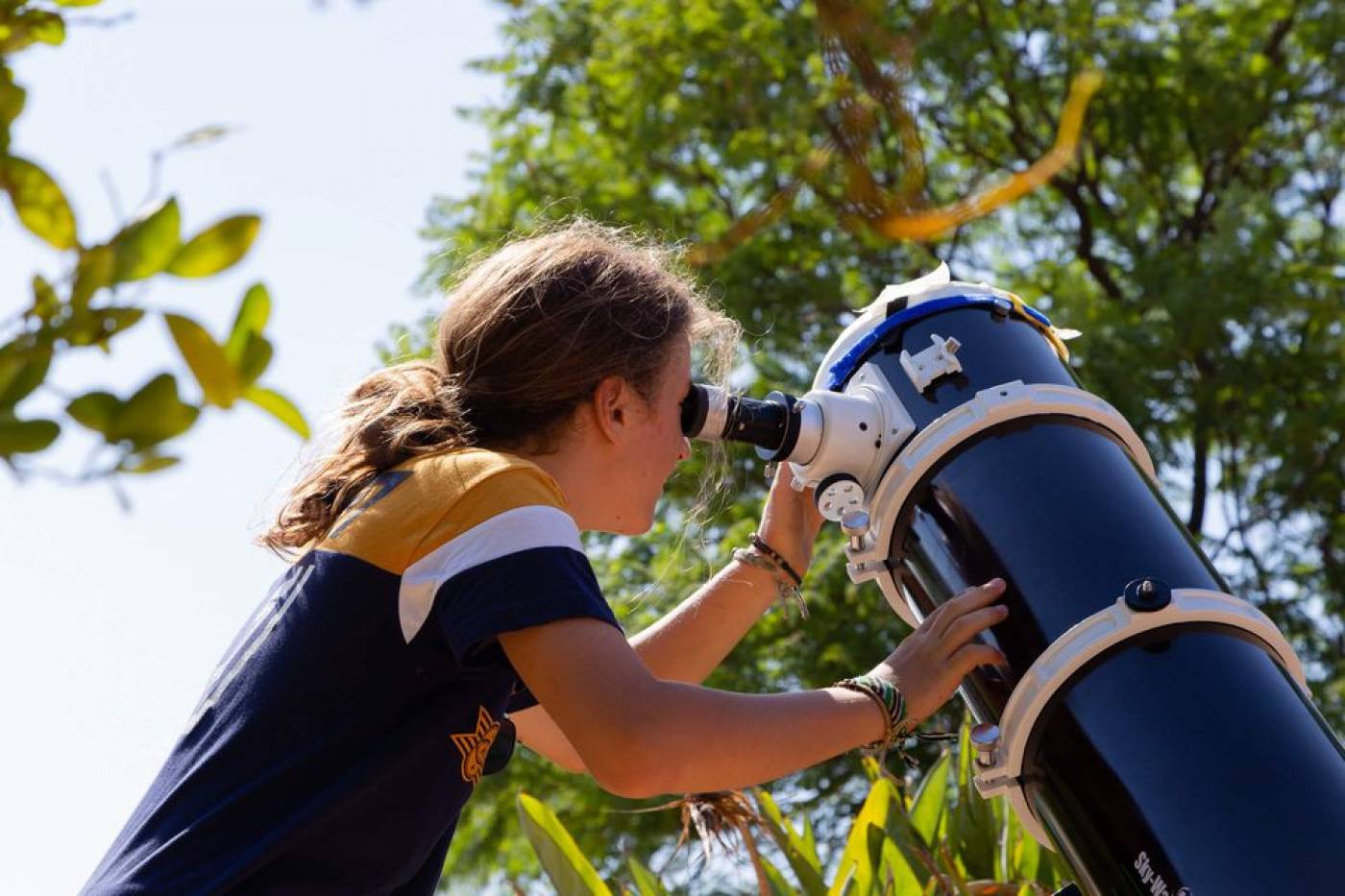
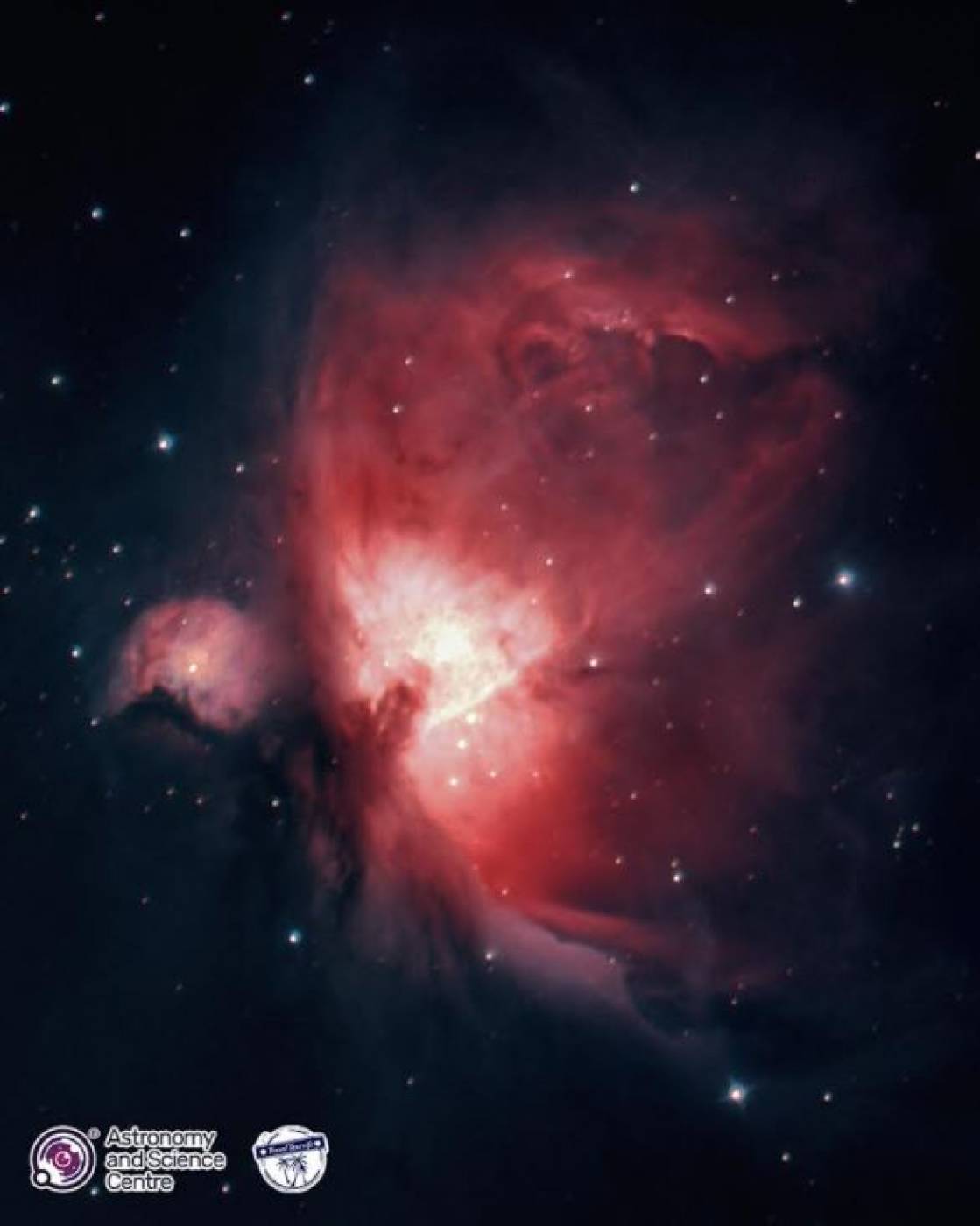 The Astronomy Tours and the Finca Astronomica are supported by the Astronomy and Science Centre Foundation, which was founded in 2019 by a group of astronomers and Starlight-certified guides and monitors in the astronomical observatories in Spain.
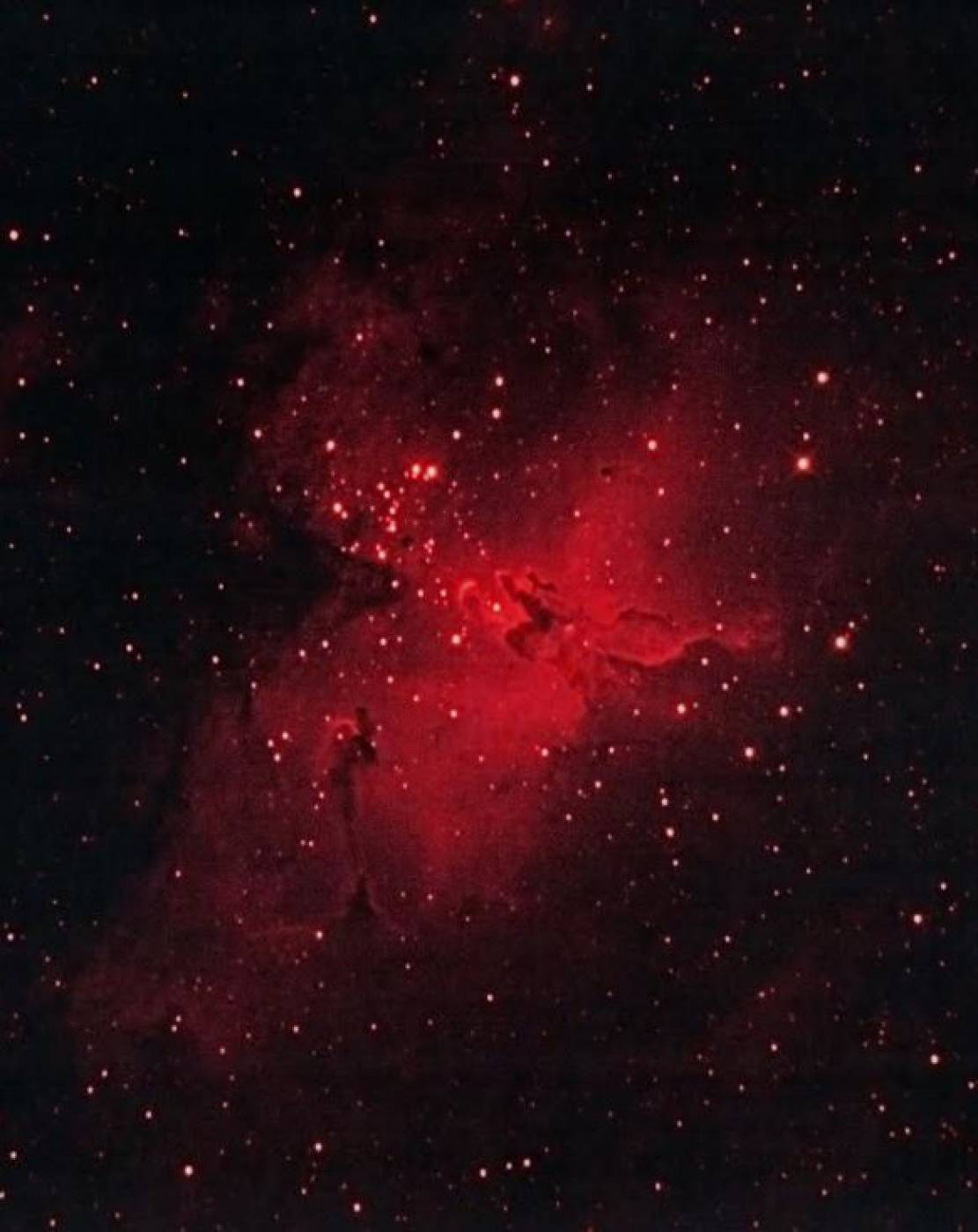 schools and organisations and write books for children to bring astronomy to the masses.